When a school joins the Third Coast Learning Collaborative (TCLC), conversations start with classrooms where students do real interdisciplinary work, teachers work in teams instead of on their own, and assessment follows a student’s growth through a portfolio rather than a single grade handed down and then forgotten.
What we’ve found, though, is that if you pull on any one of those threads, the same thing keeps turning up. Team teaching requires teachers to share both planning time and students. Project-based learning depends on having enough uninterrupted, flexible time to actually build something. And portfolio assessment needs days that aren’t sliced so thin that students don’t have time to build up evidence of their learning. Each of these runs into the same constraint, and it usually isn’t pedagogy or philosophy or staff buy-in… it’s the bell schedule.
This is a lesson we’ve learned over two years with this project. We would help a team design a genuinely good interdisciplinary unit and then watch it fall short because the two teachers couldn’t find a shared period, or they didn’t have common planning to come up with robust ideas, or half their students were pulled out for an elective at a different time every day. The schedule turns out to be the thing every other change has to run on top of. If it’s built around one teacher, one room, one subject, and a forty-three-minute period, that’s more or less what you’ll get, without constantly having to talk through complicated logistics (and this burns people out).
So we’ve come to treat the schedule as the first design problem rather than the last logistical one. When the structure is right, there’s room for the pedagogy to actually work; when it isn’t, educators tend to spend the year quietly fighting their own calendar.
All of these ideas are based on our previous experiences with schools both in- and out- of TCLC; as well as language we adapted from visiting a school using a similar model at East Middle School in Farmington Hills, Michigan.
Teaming
Before getting into the schedule itself, it’s worth being clear about what all of this is in service of. The reason we spend so much time on it is teaming.
A team is a defined group of students, often the same grade level, who share the same educators throughout the day. Teams enable teachers to plan and problem-solve together instead of working in isolation, and for teachers and students to come to know one another because they spend real time together rather than passing through a forty-five-minute period. Project-based learning, interdisciplinary work, and portfolio assessment are all, underneath, relational. They depend on adults who trust each other enough to teach side by side, and on students who are known well enough that someone can push them. Teaming has a consistent positive association with relational and climate outcomes across many research studies.
This lends itself to two forms of educator agency (which in-turn leads to student agency). The first is common planning time, which the anchored schedule produces almost on its own. While a team’s students are off in their electives, the whole team is free at the same time, every day, so common planning becomes a built-in feature rather than something to keep fighting for.
The second is a team’s control over the shape of its own day. In a traditional building, the day is dictated by the bell, the room assignments, the period grid, and a schedule someone else built. A lot of what we’re after is handing that decision back, so that a team can arrange its day around the learning (how long a given block runs, when to combine groups, when to slow down, when to change course the next morning) without having to check first whether the logistics will allow it. The schedule work is really about absorbing that logistical load so the teachers don’t have to carry it, which frees up the energy they would otherwise spend fighting the calendar.
Creating Flexible Time
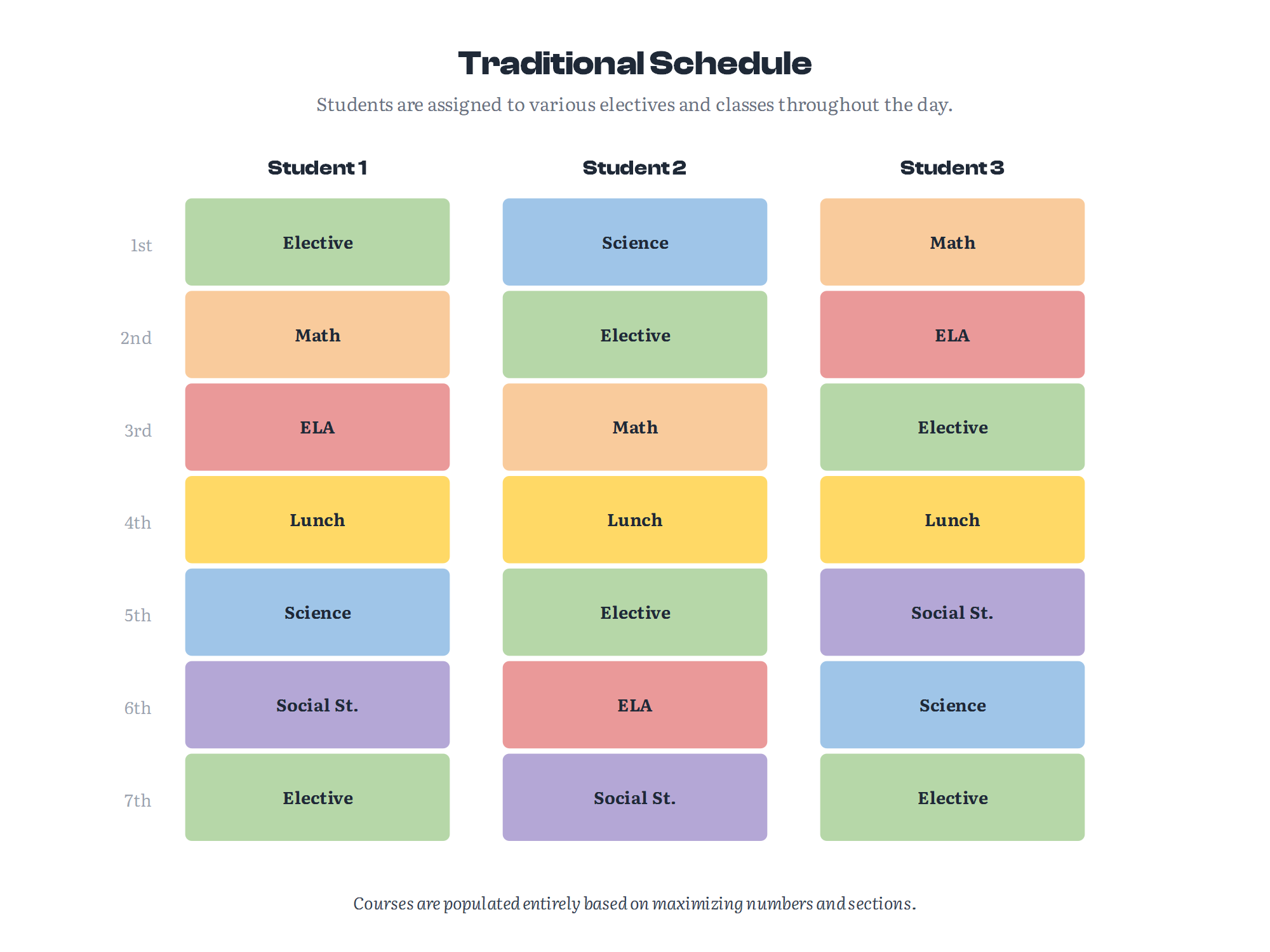
In a traditional schedule, electives are scattered across the day. Band is offered 2nd period, art is 2nd, 4th, and 5th, Spanish is 1st through 6th, etc., and each student’s day ends up as its own bespoke day because that’s when electives happen to land. Because electives are spread across every period, every period is at least partly committed, which means there’s never a stretch of time when a team has all of its students together and all of its teachers free at once.
The day is fragmented more or less by design, and that fragmentation stays invisible until you try to do something that needs a whole, shared block of time. For example, saying “Hey, let’s combine our two classes today and do this activity.” is not that simple, because you A) may not share the same group of students; B) those students will see you once or twice depending and need different plans; and C) you don’t necessarily have time to combine classes, especially not to say “let’s just make our combined class 2 hours”…otherwise you would disrupt every other class and elective.
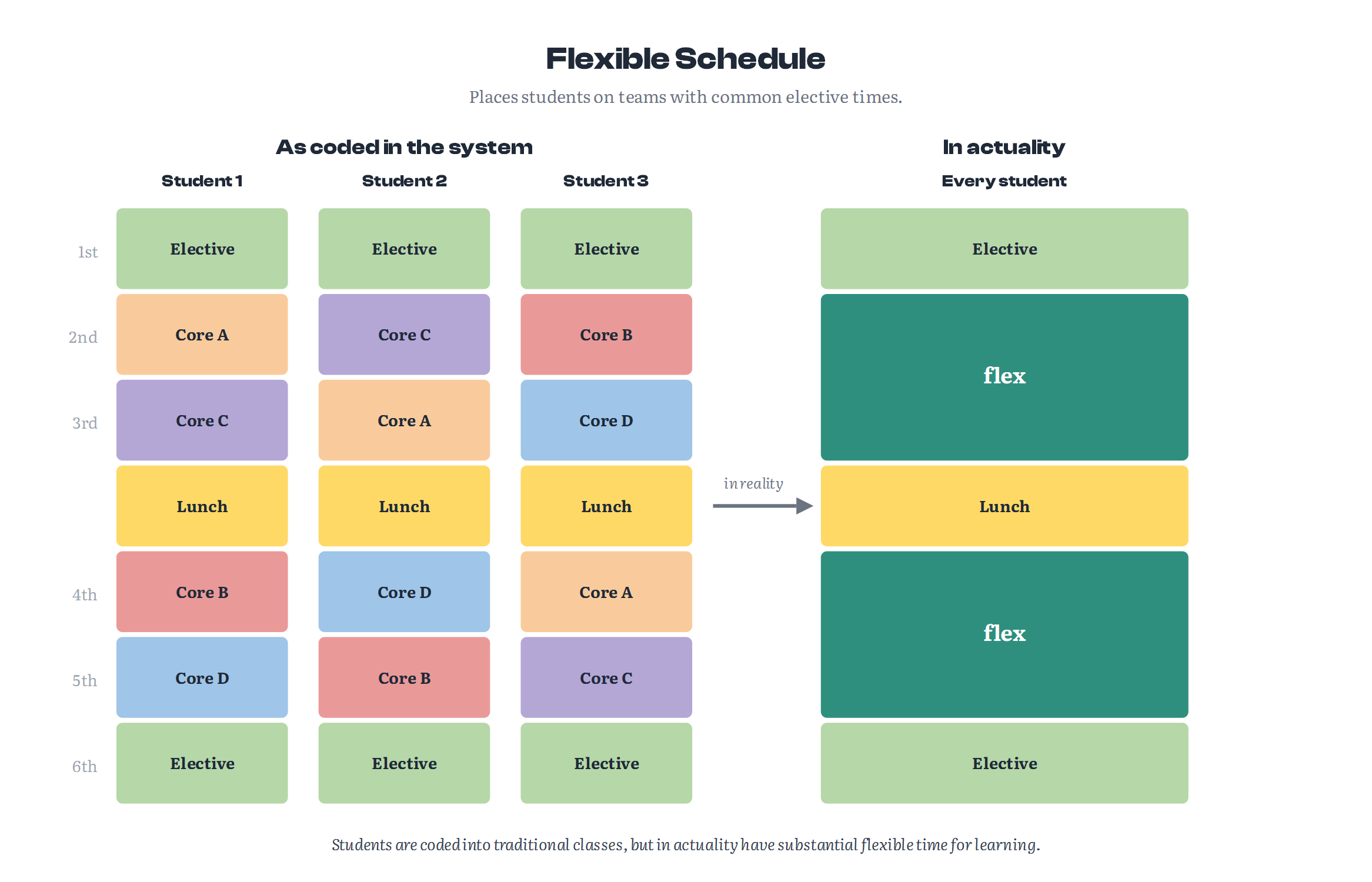
What we do instead is anchor elective periods and flex the remaining time by placing all of the following per team:
- All electives are scheduled at the same time for every student (e.g. 2nd and 4th period) (which means that electives tend to be 1 grade level)
- All students share the same group of “core” educators (which means that singleton classes and/or “tracked” classes, like AP courses, need to have a section per team – not all taught by the same educator)
- Lunch is shared across the team
Doing this opens flexible time that the team owns and divides up however the learning requires.
What it looks like
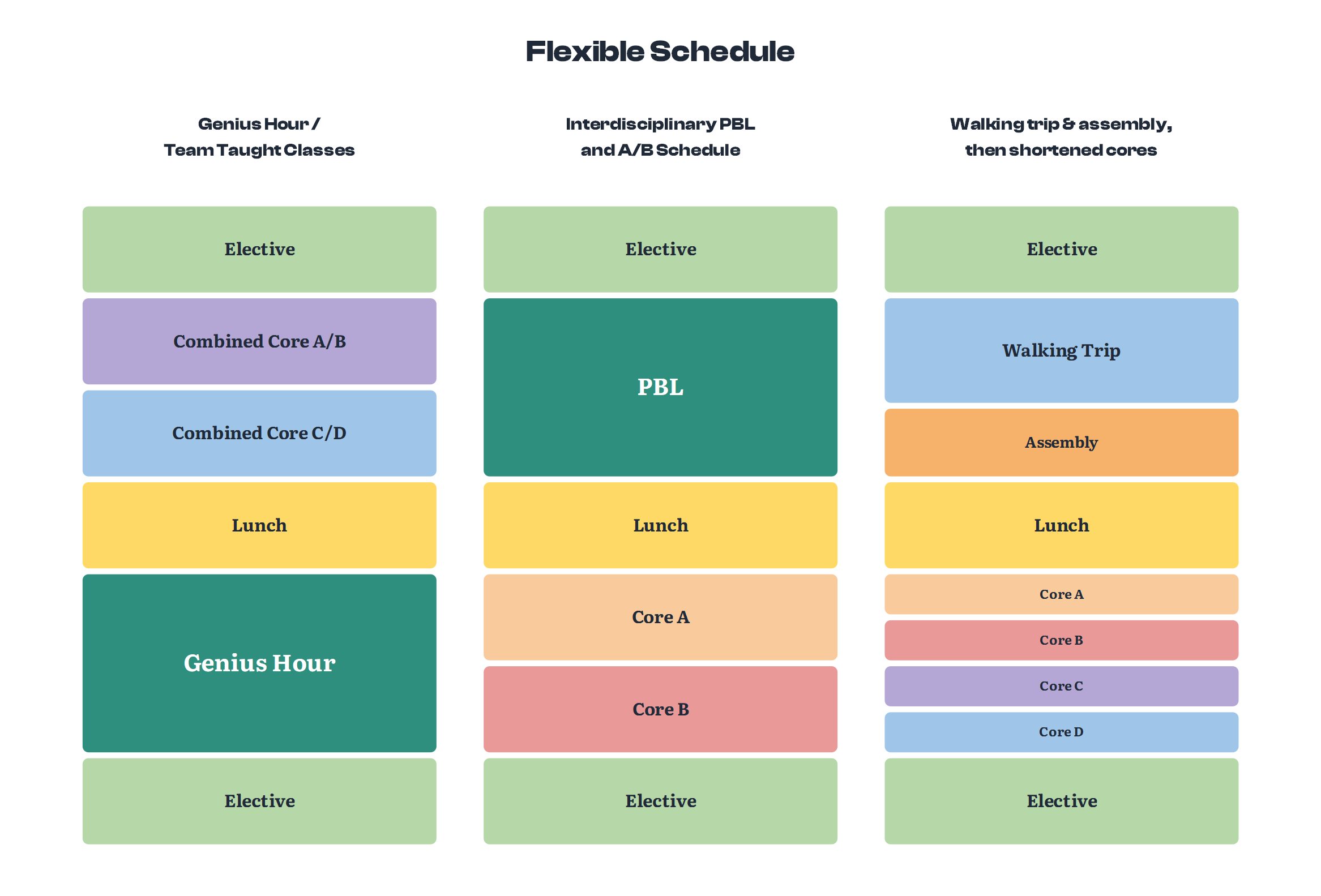
In all three tables below, a traditional “period” is the familiar single-subject block of roughly forty-five minutes, where what changes is whether those minutes stay chopped into isolated periods or get pooled into something the team can shape:
Traditional schedule: ~7 standard periods that are ~45 minutes each, with electives falling wherever they fit. Teachers usually have 2-3 preps. To change the schedule, teachers need to coordinate with many peers and electives.
Flexible schedule: the classes are coded as ~7 standard periods that are ~45 minutes each, with electives and lunch anchored for students/teachers in teams/houses. Teachers usually have 1-2 preps. To change the schedule, teachers work with their team members to coordinate within this new flexible time.
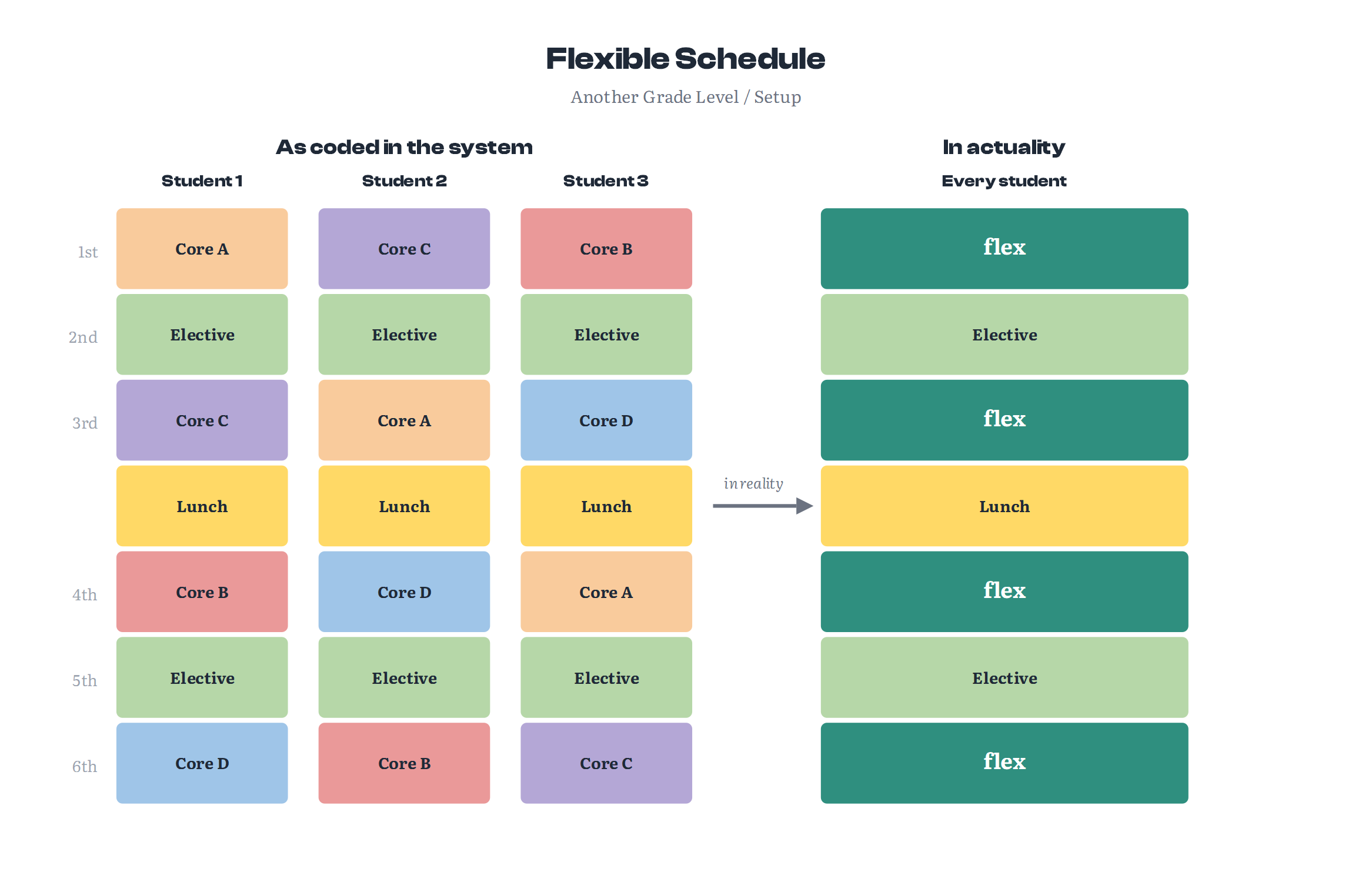
Because this time is flexible, teachers (and by extension, students) have many more opportunities to shape what the school day looks like, making it much easier for authentic learning:
The schedule (the second table) is what the back-of-house registrar is set as, which is essentially a traditional day. The above table are just some examples of what a team might do inside that front-of-house, flexible time. And what’s nice is that they can change it whenever they need to. For example, a long lab day, a full morning spent pushing on a project, two cores combined for a shared text, or a guest speaker who takes up the whole block. None of this requires coordinating with a huge group of people or changing up classes beyond the team.
Once we’ve built the foundation of this system, the same structure that took months to set up can then be adjusted in a matter of minutes. As in, classes can run long when the work calls for it. A field study, a lab, a build, or a full-morning writing workshop just means the team uses its block differently that day, without needing anyone’s permission. Teachers decide how long a core meets, in what order, and with which group of students, so the shape of the day becomes a professional decision rather than something the bell decides for them. When the timing turns out to be wrong, they change it the next day, and because adjusting costs almost nothing, teams actually do it.
The constraints, and what it takes to get there
This shift has difficult questions for educators. Below are the constraints we run into more or less every time, what each one means in practice, and the questions a team needs to work through:
1. Working with elective teachers
The model really does live or die on the electives. If every team’s electives sit in the same anchor windows, the elective teachers end up serving students from several teams in those windows, which can work well or can overload a single art room. Specials, world languages, PE, CTE, and music all carry their own constraints around equipment, certifications, and section sizes, and they’re too often the last people in the room when the master schedule gets built. We have to consider:
- Who are your elective teachers, and what are their hard constraints (room, equipment, max section size, staff shared with other buildings)?
- Can all of the electives fit in the anchor windows without ballooning section sizes? Where’s the pressure?
- How will elective staffing and rooms be balanced across the anchor windows?
- Do we have the capacity to offer additional electives via “core” teachers (in the 2-elective flex schedule, teachers have two periods of common planning)?
- Usually, a shift like this means having everyone from the same grade level in a course…how does this impact classes like Spanish 1 or electives that were traditionally “singletons” due to relatively low course enrollment?
2. Shifting to teams
If it’s a new practice, team teaching involves re-rostering students into cohorts, assigning teachers to a team rather than to a course catalog, and giving the team genuine common planning time. The anchored model hands you that planning time almost for free, since the team is together while their students are in electives:
- What’s your team size, and how many students does each team share?
- Will teachers be comfortable with being on a team with their peers? Would they be willing to experiment with the schedule and/or co-teach? Do they have shared pedagogical interests?
- Will teachers want to teach (typically) one class all day, rather than classes of multiple grade levels?
- In many cases, we’ll need parity across the teams, so can say, 2 math teachers each have a section of Algebra?
- What does that common planning time look like? Will it always have to be common planning?
3. Making it legible in the LMS / SIS
Most student information systems and learning management systems assume fixed periods, one teacher of record, and discrete course sections that meet at set times. A flexible block that a team re-divides daily can be hard to represent in that kind of system. The usual workaround is to schedule the flex as a small number of stable “container” sections in the SIS, so that attendance, transcripts, and compliance all still function, while the team manages the actual internal division of that time outside the rigid period grid. Or, boutique schedules can be programmed ahead of time based on what is working in practice.
- What does your SIS require to be true (teacher of record, seat time, attendance capture)?
- Can the flex block be represented as one or a few stable sections rather than many small ones?
- How can multiple schedules be coded into the day easily after the school year starts? E.g. A/B days, a Humanities block, etc.
4. Making the numbers work
Seat-time requirements, state-mandated instructional minutes per subject, credit accrual, FTE allocations, and contractual prep and duty time all have to net out in the end. The flexible model rarely adds minutes; it mostly rearranges the ones schools already have. But you do have to be able to show an auditor that every required minute is accounted for somewhere inside the flex:
- What are your state’s minimum minutes per subject and per day, and what counts as instructional time?
- Does the flex model, summed across the week, satisfy every core’s required minutes?
5. Culture and climate of changing schedules and rooms
A schedule that changes from day to day asks students and adults to tolerate an ambiguity that a fixed bell schedule never did. Where do students go when the block reshapes, and how do they know? What happens to the comfort of “I have math at 9:00 every day”? This can feel like chaos before it starts to feel like freedom:
- How will students know each day’s plan (a board, an app, advisory, a routine)?
- What’s the room plan, and does each team have a stable home base or do groups move?
- How will you bring students, families, and staff along before the change rather than after?
- What training and conversations will staff need to have to make use of this flexible time?
- Do all teams need to offer the exact same experience for students?
6. Special education and services
IEP and 504 minutes, pull-out and push-in services, co-teaching, related services like speech, OT, and counseling, and least-restrictive-environment commitments all have to be honored. The good news is that a predictable flexible structure can actually make service scheduling easier, since providers know exactly when each cohort is available and can create their own schedules as well. The risk is that if SPED is treated as an afterthought, students end up pulled out of the very flex block where the richest interdisciplinary work is happening.
- How are IEP and 504 service minutes delivered inside this structure without removing students from core project work?
- Are co-teaching and push-in models built into the flex by design?
- Are your service providers in the room when the schedule is being designed?
- How can IEP/504 services be improved by giving SPED educators more flexibility and autonomy in their day?
The bigger conversation
It’s worth noting that adjusting the schedule changes how teaching is meant to look and feel. Teaching the way a flexible schedule is intended is genuinely harder. It asks teachers to exercise professional judgment more or less constantly: to plan lessons collaboratively, to make creative calls about what their particular students need on a particular day, and to defend those choices, all without a manual telling them what to do at each step, and without the cover of a common curriculum that everyone is expected to use in the same way. There’s a real comfort in being handed the program and told to implement it with fidelity; if it doesn’t work, at least it wasn’t your call. Flexibility and autonomy take that comfort away and puts the responsibility back on the teacher, which is harder, and which is more or less the point.
But that difficulty is the same thing as the work being meaningful, and over the long run it’s a big part of what keeps teachers in the profession rather than driving them out. A lot of what we now file under “burnout” isn’t really exhaustion from working too many hours. It’s closer to moral injury, the slow damage of being made to do your job in a way you know is worse for the kids in front of you, over and over, with no authority to change it. Handing a teacher a script and then holding them accountable to it regardless of what’s actually happening in the room is a fairly reliable way to produce that kind of injury. Giving the work back to them, and treating their judgment as something that matters, is one of the few things that genuinely helps.
When schools shift to a flexible schedule, they are by extension moving away from scripted lessons, mandated curriculums, and pacing guides. This isn’t to say curricular resources or standards stop existing, but that when you’re working collaboratively in a small team, your professional judgment should steer you toward designing for the humans actually in the room. That means paying attention to the specific interests of the young people and the adults in the space, and it means classes will look very different from one team to the next. One pair of teachers might combine their classes for a Humanities block and run Model UN; another might go fully interdisciplinary and have students testing drones for nondestructive testing.
Administration still has to hold teachers accountable for meeting state standards, and that part doesn’t go away. But a flexible schedule doesn’t actually work if everyone is held to the same pacing guide. What is the point of opening up all of this creative time if every classroom is expected to be on Unit 3.4 by Friday? It runs against the whole pedagogical move we’re making. When we try to guarantee a common “skill floor” by standardizing how all classes look in a building, we end up flattening any real “skill ceiling.”
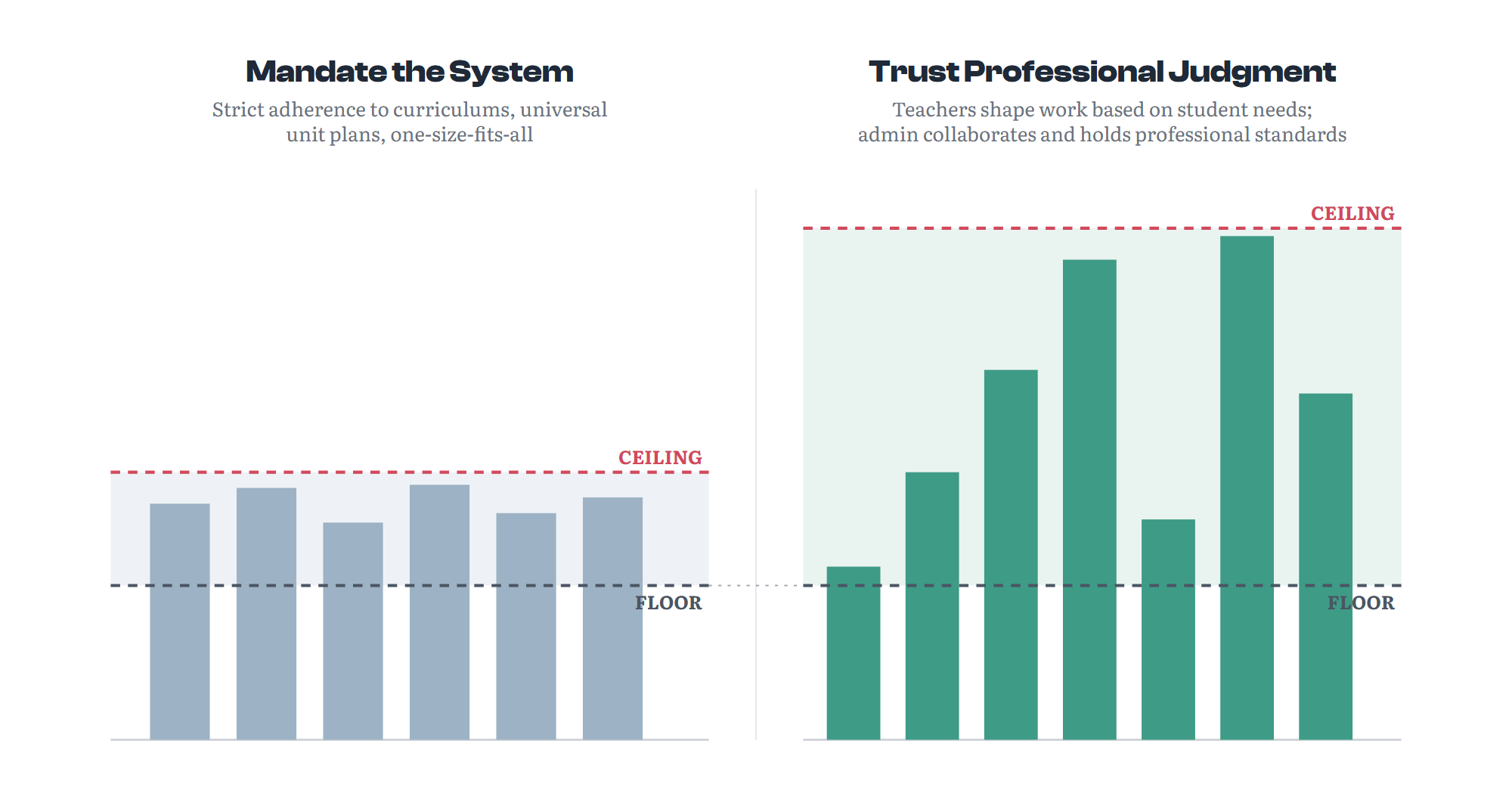
Famed school leader Deborah Meier spent her career, first at Central Park East in Harlem and then across the small schools movement, arguing that small enough, autonomous enough schools where teachers actually know the students in front of them can shape the work around who those kids are. Her schools served mostly at-risk youth and sent ~90% of them to college, and she was clear that this happened because the schools weren’t standardized, not in spite of it.
When we hand a team control over the shape of its day, we’re saying that the people in the classroom, the teachers and the kids themselves, should get to decide what learning looks like, and that two teams arriving at two different answers isn’t a failure of equity but the whole point of it. The mistake is assuming everyone should have the exact same experience; what you actually get when you enforce that is a worse experience for everyone, because sameness is only achievable at the level of the lowest common logistical denominator. Meier’s insight, and ours, is that an education worth having has to be expressive, responsive to the particular people in the room, and that uniformity, far from protecting the most vulnerable kids, is usually what flattens them.
The schedule is just the most stubborn place where a deeper commitment gets decided: whether we believe the people closest to the learning, the teachers and the students themselves, should have real authority over how their days go. Redesigning the schedule is what makes that belief practical and what you get on the other side is a school where teachers are trusted as professionals and students are known as people, where two classrooms can look nothing alike and that is a sign of health rather than a problem to be corrected. It gives the humans in every school the room to build something that actually fits them.