Tasty! Nutritious Smoothies
6th Grade, Reeths-Puffer Intermediate
How do the foods we eat affect our bodies, and how can we design products that help people make better choices?
In Tasty! Nutritious Smoothies, students investigate how the foods we eat affect our bodies—and then design products that help people make healthier choices. The project treats nutrition as both a personal and a community issue, asking students to weigh taste, cost, and health while paying attention to food access, dietary restrictions, and the food traditions their families bring to the table.
The unit opens with a taste-test hook, where students identify mystery ingredients and spices and build a vocabulary for describing flavor and aroma. From there they map their community's food landscape—where families actually shop and eat—surfacing questions about food deserts, the cost of convenience, and why processed foods are priced and marketed the way they are. Across subjects, students read the book Tasty, analyze nutrition labels, scale recipes using fractions and ratios, compare the cost of a store-bought smoothie to one they make themselves, and study the body systems that turn food into energy.
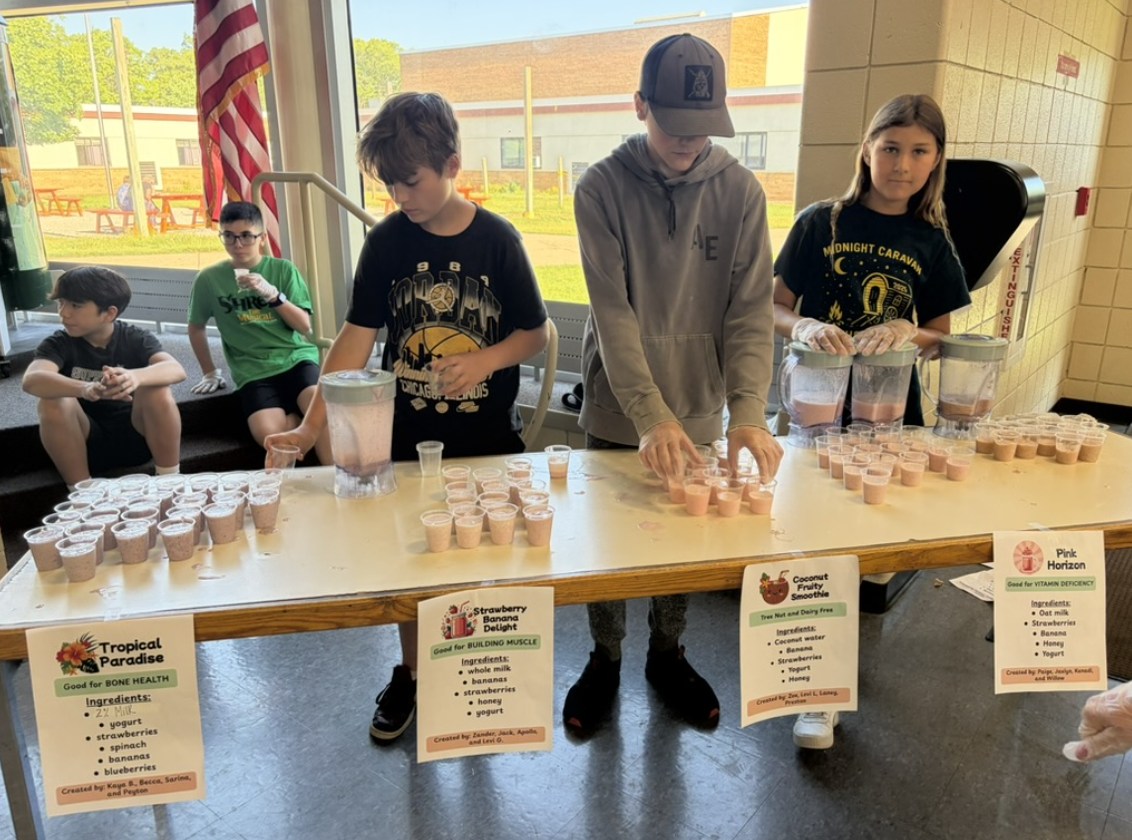
Working through the design-thinking process, students empathize with real eaters, define a nutrition problem worth solving, and prototype their own smoothie recipes—balancing flavor with nutritional value. Each team develops a one-page deliverable (a nutrition label, recipe, and average cost per serving, paired with a graphic-novel page or infographic) and refines it through peer feedback and product reviews. The project culminates in a smoothie-making and tasting event, with student work shared at the ISD showcase.
Resources
Community Partners
- Northside Nutrition (smoothie partner & entry event)
- MI Little Cooks (field trip)
- Rootdown
Standards Alignment
Best-guess alignment, pending confirmation by the teaching team.
Science (Michigan Science Standards / NGSS)
- MS-LS1-7: Develop a model to describe how food is rearranged through chemical reactions forming new molecules that support growth and/or release energy. *(Nutrients, digestion, and food as energy)*
- MS-LS1-3: Use argument supported by evidence for how the body is a system of interacting subsystems composed of groups of cells. *(Body systems)*
- MS-LS2-1: Analyze and interpret data to provide evidence for the effects of resource availability on organisms and populations in an ecosystem. *(Where our food comes from)*
- MS-ESS3-4: Construct an argument supported by evidence for how increases in human population and per-capita consumption of natural resources impact Earth's systems. *(Food waste and environmental impact)*
- MS-ETS1-1: Define the criteria and constraints of a design problem with sufficient precision to ensure a successful solution. *(Designing the smoothie product)*
Mathematics (CCSS, Grade 6)
- 6.RP.A.2/3: Understand unit rate and use ratio and rate reasoning to solve real-world problems. *(Recipe scaling and unit pricing)*
- 6.NS.A.1: Interpret and compute quotients of fractions. *(Scaling recipes up and down)*
- 6.NS.B.3: Fluently add, subtract, multiply, and divide multi-digit decimals. *(Cost-per-serving analysis)*
- 6.EE.B.7: Solve real-world problems by writing and solving one-variable equations. *(Budgeting ingredients)*
- 6.SP.B.4/5: Display and summarize numerical data in plots and with summary statistics. *(Student-collected lunch and preference data)*
English Language Arts (CCSS, Grade 6)
- RI.6.1: Cite textual evidence to support analysis of what an informational text says explicitly as well as inferences drawn from it. *(Reading Tasty and nutrition labels)*
- RI.6.7: Integrate information presented in different media or formats as well as in words to develop understanding. *(Labels, infographics, and data)*
- W.6.1: Write arguments to support claims with clear reasons and relevant evidence. *(Making a nutrition claim)*
- W.6.2: Write informative/explanatory texts to examine a topic and convey ideas, concepts, and information clearly. *(One-page graphic novel / infographic)*
- SL.6.4/5: Present claims and findings and include multimedia components to clarify information. *(Showcase and product reviews)*
- L.6.6: Acquire and use grade-appropriate general academic and domain-specific vocabulary. *(Descriptive language for taste and aroma)*
Social Studies (Michigan Grade 6 GLCEs — Geography of the Western Hemisphere)
- 6-G1.1.1: Use a variety of geographic tools (maps, globes, web-based technology) to analyze the world at global, regional, and local scales. *(Community food map)*
- 6-G1.2.3: Interpret and create maps displaying population characteristics, natural features, and land-use patterns. *(Mapping food access and food deserts)*
- 6-G5.1.1: Describe how humans have impacted and continue to impact the environment through population size, resource use, consumption, and technology. *(Food systems and waste)*
- 6-E1.1.1: Explain how incentives and disincentives in the market economy can change the decision-making process. *(Cost, marketing, and food choices)*
- 6-E3.3.1: Use charts and graphs to compare imports and exports and propose generalizations about economic patterns. *(Where ingredients come from)*
- 6-P3.1.1: State an issue as a public-policy question, trace its origins, and evaluate alternative resolutions. *(Food access as a community issue)*
- 6-P4.2.2: Engage in activities intended to contribute to solving a local, national, or global issue studied. *(Designing products that help people make better choices)*